
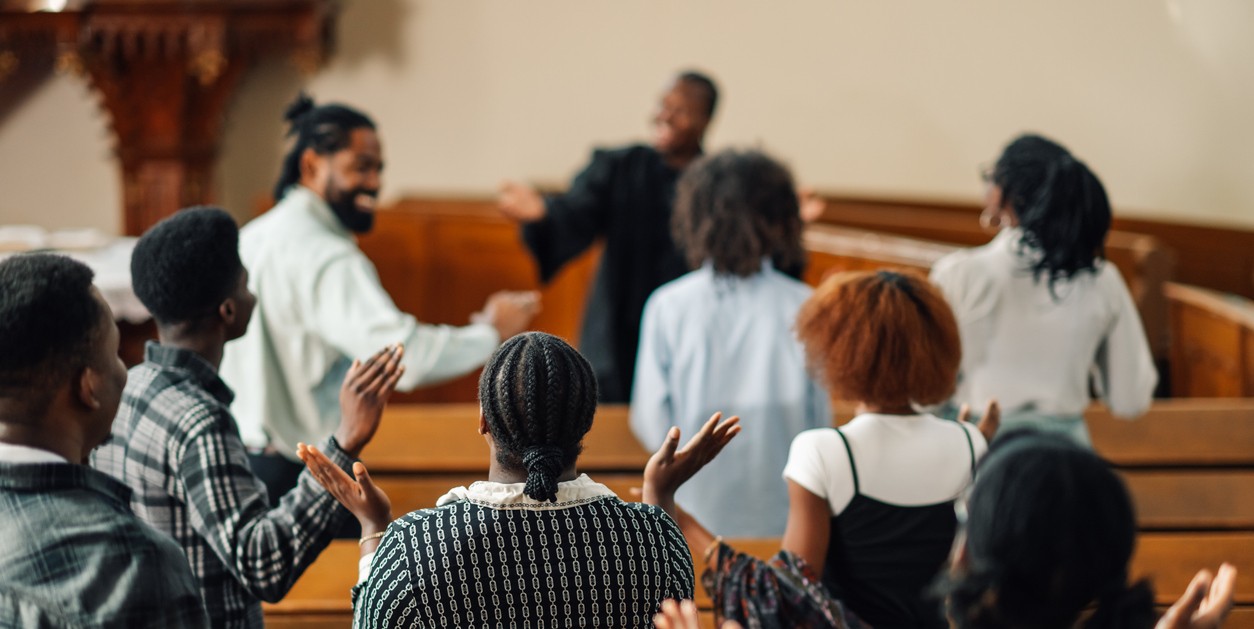
On a Sunday morning in Mississippi, a pastor rises to speak. The sermon may begin with scripture, but it rarely ends there. It stretches into the realm of public life — into questions of authority, justice, belonging, and the meaning of the nation itself. In the Southeast, this is not an anomaly. It is the civic grammar of the region. Churches are not simply houses of worship; they are the primary institutions through which millions learn how to interpret the world.
Christian Nationalism as a Structural Weight on Democratic Life
This interpretive power is not benign. It is structural. It shapes how people understand legitimacy, how they imagine the Constitution, how they define who belongs inside the circle of “the people,” and who stands outside it. In much of the region, this formation has been organized around a coherent framework of Christian nationalism — a worldview that binds religious identity to political authority and national destiny. PRRI’s research shows how deeply this framework has taken root, particularly in the Southeast, where faith and civic identity have long been intertwined.
Christian nationalism functions as a weight on democratic practice. It does not merely influence political preferences; it shapes the very categories through which democratic life is interpreted. It offers a story about the nation that claims constitutional legitimacy while bending constitutional principles toward exclusion. It provides a sense‑making system — durable, emotionally resonant, institutionally embedded — that precedes and shapes every civic action that follows.
This weight did not emerge by accident. It is the product of decades of investment in churches, media ecosystems, leadership pipelines, and theological narratives that merge faith with national identity. It is a system built upstream of civic behavior, upstream of elections, upstream of policy. It is a system that shapes meaning before meaning shapes action.
Philanthropy’s Current Counterweight: Downstream Action Without Upstream Interpretation
Philanthropy has not ignored the Southeast. It has invested in voter engagement, grassroots organizing, and policy advocacy. Organizations like Mississippi Votes, Mississippi Engaged, and the Georgia Muslim Voter Project have demonstrated what community‑rooted civic engagement can accomplish when given resources and trust. National funders — Democracy Fund, Freedom Together Foundation, and others — have committed meaningful support to democracy efforts in the region.
But these investments, for all their value, operate downstream of the systems that shape civic meaning. They attempt to mobilize participation without engaging the interpretive frameworks that determine whether participation feels legitimate, necessary, or even faithful.
This is not a failure of decision‑makers. It is the result of a missing interpretive lens — the assumption that civic infrastructure is secular by default, and that faith communities can be “reached” without investing in the institutions that form them. Philanthropy has funded democracy as a field of action while bypassing the field of meaning that precedes it.
The result is a counterweight that cannot balance the weight. Mobilization cannot counter formation. Information cannot counter identity. A downstream strategy cannot balance an upstream system of civic meaning‑making.
The Structural Asymmetry: Why the Current Strategy Cannot Hold
The imbalance between weight and counterweight is not simply a matter of scale. It is a matter of structure.
Christian nationalist infrastructure is institutionally embedded. Civic engagement organizations are not. One side has pulpits, denominations, media channels, and leadership pipelines. The other has programs and campaigns.
One side works on a generational timescale. The other works on grant cycles.
One side offers a totalizing narrative about the nation and its purpose. The other offers information about elections and issues.
This asymmetry is not incidental. It reflects long‑term investment in institutional capacity and narrative coherence. As Third Plateau notes, faith‑based organizations that receive sustained investment develop durable civic infrastructure; those that do not remain episodic and fragile.
Philanthropy’s current strategy does not address this asymmetry because it does not engage the upstream systems of interpretation. It does not contest the meaning of the Constitution, the nature of authority, or the obligations of citizenship. It does not offer a counter‑narrative capable of meeting Christian nationalism on its own terrain.
The Real Counterweight: Faith‑Based Civic Formation Rooted in Constitutional Principles
A real counterweight must match the structure of the weight itself. It must be faith‑based, because the dominant civic formation system in the region is faith‑based. It must be constitutionally grounded, because the contest is over the meaning of the founding documents. And it must be historically defensible, because Christian nationalism relies on historical distortion.
This counterweight is faith‑based civic formation — the slow, intentional work of shaping how communities understand the relationship between their faith, the Constitution, and the democratic commitments that have defined the American experiment.
This formation teaches how constitutional principles and democratic commitments integrate with core faith claims. It does not ask people to abandon their faith. It asks them to see how their faith can speak truthfully about liberty, equality, conscience, and the responsibilities of citizenship.
It is a civic formation project expressed within faith language, because that is the language through which millions in the region make sense of obligation and belonging. And it is an attempt to align faith‑rooted civic identity with defensible commitments within the American democratic tradition — commitments that have been contested, expanded, and fought for across generations.
This is the counterweight: a faith‑rooted, constitutionally grounded civic formation capable of meeting Christian nationalism on its own terrain.
What Building This Counterweight Requires
Such formation cannot be built through episodic programs. It requires institutions — places where people gather, learn, and return. It requires leaders who can speak with moral authority about the difference between a faith that blesses power and a faith that disciplines it. It requires the patient work of building trust in communities that have learned to expect outsiders to arrive with urgency and leave with disappointment.
Some organizations are already showing what this looks like. Fair Count has built long‑term relationships across the region, weaving civic engagement into the fabric of community life. The Georgia Interfaith Public Policy Center has developed faith‑rooted civic education and leadership development that helps communities understand their role in public life. The First Episcopal District of the CME Church has demonstrated how congregational networks can sustain civic formation through trainings, convenings, and coordinated public engagement.
At the national level, the Center for Christianity & Public Life offers a model of faith‑based civic infrastructure — investing in leadership development, fellowships, and convenings that shape how Christian leaders engage public life. While not regionally concentrated in the Southeast, its work illustrates the kind of sustained investment required to build durable sense‑making systems.
These examples are not theoretical. They are living demonstrations of what durable, faith‑based civic infrastructure can look like. But they remain exceptions in a landscape dominated by short‑term mobilization.
The Civil Rights Movement as Proof of Concept: When Faith‑Rooted Civic Formation Reshapes a Democratic System
If we want to understand what a real counterweight can accomplish — what becomes possible when faith‑based civic formation aligns with constitutional principles — we do not have to imagine it. We have already seen it. The Civil Rights Movement stands as the clearest historical demonstration of what happens when communities are formed in a moral vision that draws simultaneously from faith claims, the Constitution, and the long arc of democratic struggle.
The movement emerged from decades of formation — the kind of formation that taught people to see themselves as bearers of divine dignity and constitutional promise at the same time. In his book, biographer R. Jelks described how Benjamin Mays shaped a generation of leaders by insisting that the work of democracy was sacred work. In The Unfinished Dream, Riggins R. Earl describes a tradition in which Black religious leaders taught their communities to interpret American democracy as an unfinished covenant — a project requiring their participation because their dignity demanded it.
The institutions of the movement carried this formation into public life. SCLC organized moral vision before it organized marches. SNCC’s grassroots organizing was a form of civic discipleship, rooted in a theological anthropology that affirmed the agency and worth of every person.
In his history of the Black social gospel, Gary Dorrien shows why this formation had such power: it linked Christian ethics to democratic struggle long before the movement emerged. In Democracy and Tradition, Jeffrey Stout helps us see the democratic implications: the movement cultivated communities capable of moral discourse, democratic reasoning, and sustained agency under pressure.
The Civil Rights Movement was a counterweight — not only to segregation, but to the entire interpretive system that justified it. It met segregationist theology with a theology of justice. It met constitutional distortion with constitutional clarity. It met a narrative of exclusion with a narrative rooted in both scripture and the founding ideals of the republic.
This is not nostalgia. It is historical evidence. It shows that when faith‑based civic formation is aligned with constitutional principles, democratic commitments, and the moral memory of a people, it can shift the trajectory of the nation.
The Southeast as the Strategic Priority — and the Root System of American Authoritarianism
The Southeast is not simply a region where faith and civic identity are intertwined. It is the region where the United States built its most enduring structures of authoritarian control — legal, cultural, economic, and theological.
Martin Luther King Jr. understood this clearly. In Why We Can’t Wait (1964), he described the South as a place where democratic promises were systematically denied through “a system of segregation that sought to cripple the mind and imprison the soul” — a system enforced through law, custom, and violence. In Where Do We Go From Here: Chaos or Community? (1967), he argued that the South had long been governed by “a tyranny of custom” and “a closed social order” that functioned as a form of authoritarian rule.
This matters because the contemporary discourse about the “rise” of authoritarianism often treats it as a new phenomenon — something emerging suddenly, mysteriously, in the last decade. That framing is not only historically inaccurate; it is condescending to the people who have spent generations confronting its structures.
Authoritarianism in the United States did not rise.
It was planted.
It was cultivated.
It was defended.
And it was resisted — most fiercely — in the Southeast.
The region is the root system of American authoritarianism, and it is also the root system of the most powerful democratic counterweight the nation has ever produced.
If philanthropy wants to shape the future of American civic life, this is the region where the counterweight must be built — not because the Southeast is uniquely broken, but because it is uniquely formative. It is where the nation’s deepest democratic wounds were inflicted, and where the most powerful democratic healing has already begun.
The Decision Before Philanthropy
Faith already shapes civic life in the Southeast. The only question is how.
Philanthropy can continue funding downstream civic engagement and hope it offsets upstream formation. Or it can invest in the only strategy capable of balancing the existing weight: faith‑based civic formation rooted in constitutional principles and expressed through the moral vocabulary communities already trust.
To decline is not neutrality. It is a decision to leave the existing weight intact.
The counterweight will not build itself.
Jarvis Williams is a Democracy Fellow with the Horizons Project.